
Full restoration
Complete refurbishment of antique furniture: cleaning, structural repairs, surface treatment and hand-polished finish - true to the original, preserving substance.
Professional restoration of antique furniture in our workshop in Darmstadt, Germany - traditional techniques, craftsmanship with care.

For decades Heymann Antiques has been restoring and repairing antique furniture from every era. We work exclusively with traditional materials and techniques suited to the piece and its time of origin.
Our goal is always to preserve original substance while restoring function and appearance - whether it is an inherited family heirloom, a flea-market find or a piece from our own showroom.
Complete refurbishment of antique furniture: cleaning, structural repairs, surface treatment and hand-polished finish - true to the original, preserving substance.
Targeted repairs of individual damage: loose joints, broken parts, sticking drawers, broken locks or missing hardware.
Refreshing and rebuilding hand-polished surfaces, wax and oil treatments. Removal of water marks, scratches and discoloration.
Repair and completion of veneer and marquetry. We use historically appropriate woods and techniques.
Re-upholstering antique seating with traditional materials such as horsehair, sprung seat and webbing - with your choice of fabric on request.
Replacement of chair caning and rattan work - done by hand, true to the original.
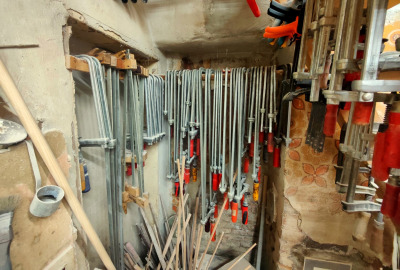
A look at our daily work - traditional materials and tools we have used for decades.



For on-site inspections we charge €0.50 per kilometre (round trip) and a flat fee of €120.00. When a restoration order is placed, this amount is fully credited against the order.
Costs depend strongly on the piece, condition and scope. As a guideline, a simple polish refresh on a Biedermeier chest starts at a few hundred euros, while a comprehensive restoration with veneer repair, hand polishing and fitting work can run into the low four figures. Each restoration is quoted individually after inspection. We provide a written estimate before starting, with no obligation.
Depending on scope and current workshop load, a smaller restoration takes about two to four weeks, a comprehensive restoration with hand polishing four to eight weeks. We agree a binding deadline before starting work and keep you updated.
Yes, we restore antique furniture regardless of where it was purchased. The piece should be at least 80 to 100 years old; modern furniture and reproductions are usually not economical to restore in our workshop.
No, preserving authentic patina is core to our work. We work conservatively, that is, we preserve original substance wherever possible and only intervene where structurally or aesthetically necessary. A heavily refinished surface can in fact reduce the collector value of an antique piece.
Traditional hand polishing produces a deep, warm sheen using a wool and linen pad and many thin layers, applied entirely by hand. Modern lacquer creates a uniform, hard film. For antique furniture hand polishing is the original technique and significantly better suited to material and age. Hand polishing can be repaired locally; lacquer usually has to be removed completely.
Both options work. We pick up regionally with our own vehicle (within reasonable range of Darmstadt). Pieces from further afield can be brought to us, sent by furniture forwarders, or for an additional charge picked up nationwide.
Yes, we prepare cost estimates for insurance and damage cases (e.g. moisture damage, transport damage, fire). We coordinate directly with the insurance company on request and document the work in writing.
Describe your request - we will get back to you soon with an initial assessment.